This page covers our response to the following ESS announcements:
Changes required from 1st July 2026 updates for Safeguard Rule change commencing 1 July 2026:.
Highlights:
- New co-payments for D16/F4 Activities
- New calculation formulas for D16/F4 and HVAC1/HVAC2 (effective 1st July 2026)
- Product eligibility changes for D16/F4 and HVAC1/HVAC2
- Calculation changes for F16 and F17 (commencing next year)
- Updated ESS Form versions.
Co-payments for Air Con D16 and F4 Activities.
We have added the following new co-payment questions for HEER D16 implementations:
HEER Co-Payment Required - Tier 1 ($500 + GST) (Applicable for systems which are not multi-split and ducted systems)
HEER Co-Payment Required - Tier 2 ($1,000 + GST) (Applicable for multi-split and ducted systems with a cooling capacity of less than or equal to 15kW)
HEER Co-Payment Required - Tier 3 ($2,000 + GST) (Applicable for multi-split and ducted systems with a cooling capacity greater than 15kW less than 20kW).
HEER Co-Payment Required - Tier 4 ($3,000 + GST) (Applicable for multi-split and ducted systems with a cooling capacity greater than 20kW)
We have added the following new co-payment questions for HEAB F4 implementations:
HEAB Co-Payment Required - Tier 1 ($1000 + GST) (Applicable for systems which are not multi-split and ducted systems)
HEAB Co-Payment Required - Tier 2 ($3000 + GST) (Applicable for multi-split and ducted systems)
When a product is imported from our register, or when its attributes are updated, the required co-payment is added as a child question. See the example below.
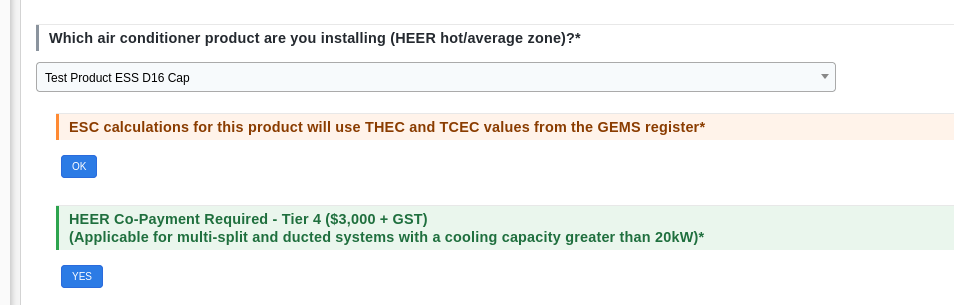
VEU co-payments, as described in the scheme rules, include GST, whereas ESS co-payments do not. For example, the customer would pay $3,300 rather than $3,000.
Valid From and Valid To fields to a date such as 01-01-2000 to 01-01-2000, disabling will not be sufficient, ASAP will
enable them on next product import or attribute update.
Indoor Units For Multi-Split Questions
These ESS changes require us to collect the indoor units used in the installation of a multi-split system.
When the GEMS product class attribute has a value of 18–21 or 27, a new child question is added. An example is shown below.
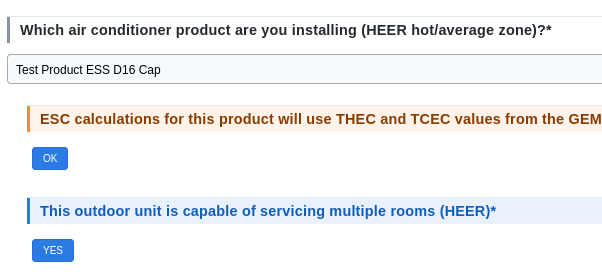
This question is mandatory and must be answered. When IPART releases the finalised evidence requirements, we may add additional evidence questions. We currently ask for a single photo of the indoor unit and a selected room description.
Indoor products use a new category, D16/F4: A/C Indoor Unit, to enable them to be discounted through certificate discounts. We assign them an activity, such as D16 or F4. If you are installing under both activities, two products will be required, one for each activity.
We re-used the product attributes D16/F4: GEMS Cooling Capacity (kW) and D16/F4: GEMS Heating Capacity (kW) for the heating and cooling capacities.
Please email support@dataforce.com.au with the brand, model numbers, and heating/cooling capacities so we can add them to your instance.
Cap Calculations for Multi-Split
After 1 July 2026, installations of multi-split systems under D16 are capped at 70 ESC for the average zone and 90 ESC for the cold zone, while the PDRS HVAC1 activity is limited to 500 PRC.
We have been advised by IPART that any TESSA submissions must be capped at the relevant energy-saving limit. We have updated the implementation data files for activity D16 to return the capped value for multi-splits.
This is calculated by working backwards:
- 70 ESS in the metro zone would be: 70 / 1 / 1.06 = 66.0377 MWh
- 70 ESS in the regional zone would be: 70 / 1.04 / 1.06 = 63.497 MWh
We are not rounding the value; we truncate it to three decimal places. If we rounded it, the result could exceed the cap in some combinations.
Indoor Unit Capacity Factors
We have added two new calculations for indoor units that mirror a similar calculation in the VEU:
- A/C: Cooling Capacity (sum of head units)
- A/C: Heating Capacity (sum of head units)
If the combined capacity of the indoor units is less than the GEMS capacity of the outdoor unit, a calculation modifier such as D16/F4: Heating Capacity (Sum of Indoor Units) or D16/F4: Cooling Capacity (Sum of Indoor Units) is used in the Reference Heating and Reference Cooling calculations.
Product Eligibility Changes
The ESS updates to use GEMS classes for product eligibility mean that a small percentage now have different eligibility.
We have created new versions of the existing product questions:
- Which air conditioner product are you installing (HEAB cold zone)?
- Which air conditioner product are you installing (HEAB hot/average zone)?
- Which air conditioner product are you installing (HEER hot/average zone)?
- Which air conditioner product are you installing (HEER cold zone)?
These above questions use new versions of the product eligibility attributes. The previous attributes have been renamed to D16/F4: Legacy Hot/Average zone eligible and D16/F4: Legacy Cold zone eligible.
To avoid issues with existing jobs these question start from the deployment date to your instances.